Retrieval-Augmented Generation (RAG)
Objective
Build a retrieval-augmented generation (RAG) system that extracts data from GitHub using the GitHub API. The extracted content is stored in a vector database (Weaviate) to enable efficient semantic search. When a user submits a question through an asset at run time, relevant context is retrieved from Weaviate and passed to OpenAI to generate a response grounded in the source material.
Architecture
Dagster Architecture
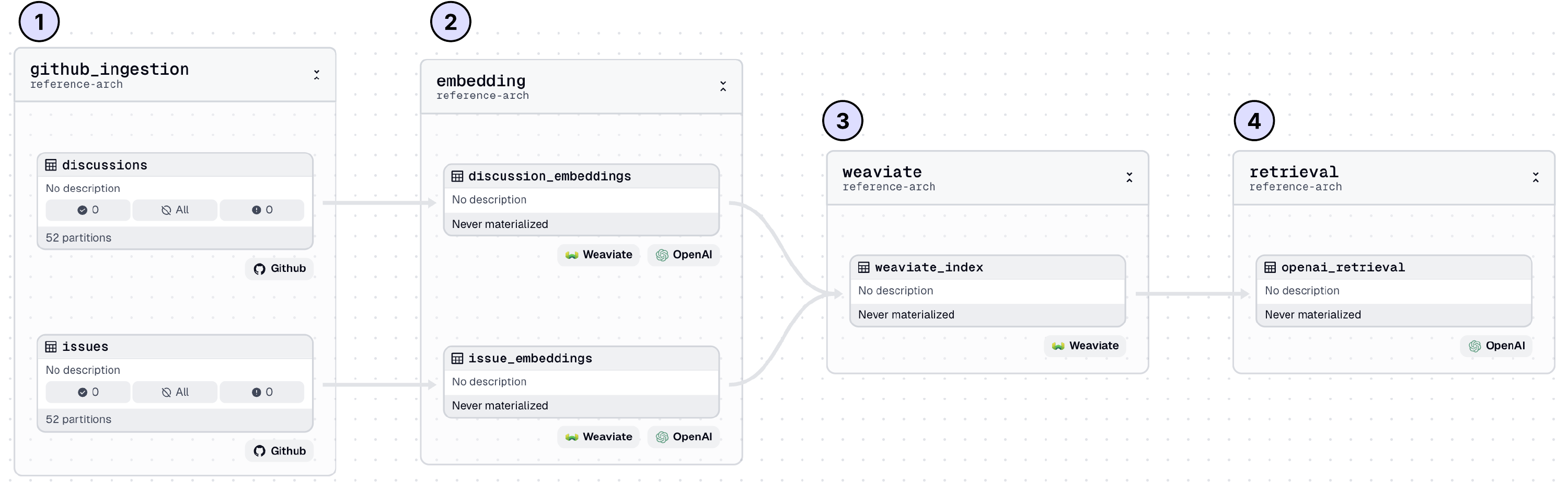
1. Github ingestion
Data is extracted from GitHub using the GitHub GraphQL API and can be implemented as a custom resource in Dagster. To avoid unnecessary re-importing, the data can be partitioned and scheduled, ensuring only new or updated content is fetched during each run.
Dagster Features
2. Generate embeddings
The raw unstructured data from GitHub must be converted into vector embeddings before it can be inserted into a vector database. Using an LLM like OpenAI, the text is transformed into embeddings that capture its semantic meaning for efficient retrieval.
Dagster Features
3. Upsert embeddings into Weaviate
An index is managed in Weaviate to store embeddings, with new or updated GitHub embeddings continuously loaded into the index as changes occur.
Dagster Features
4. Retrieve information with OpenAI
An asset is configured with a run configuration to enable dynamic runtime execution. This allows questions to be posed to the LLM with the added context of data stored in the vector database.
ops:
  openai_retrieval:
    config:
      question: What is Dagster?
Dagster Features